Model guide#
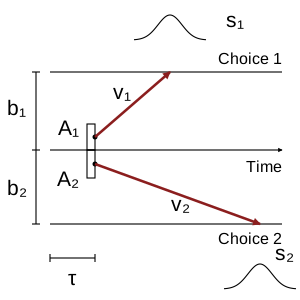
The accumulator race#
Each accumulator begins at a point drawn uniformly between zero and A.
Its drift is drawn from a normal distribution with mean v and standard
deviation s, independently truncated above zero. Evidence increases at
that constant drift until it reaches threshold b.
The finish time is tau + (b - start) / drift. The first accumulator to
finish determines both the response and its response time.
Parameter |
Meaning |
Domain |
|---|---|---|
|
Upper bound of the uniform starting point |
Positive |
|
Response threshold |
Greater than |
|
Mean of the underlying, untruncated normal drift |
Finite |
|
Standard deviation of the underlying normal drift |
Positive |
|
Non-decision time |
Non-negative |
Times and non-decision times must use the same units. v is the mean of
the underlying normal distribution, not the mean after truncation.
Working with parameters#
Parameter fields accept scalars or one-dimensional vectors. Scalars broadcast across the race; vectors must match its accumulator count.
from pyLBA import LBAParameters

parameters = LBAParameters(A=1, b=[2, 3], v=2, s=1, tau=0.1)
print(parameters.validate())
values = parameters.to_dict()
restored = LBAParameters.from_dict(values)
thresholds = parameters.b.value
validate checks numeric parameter values and shapes. Simulation rejects
invalid parameters. During fitting, parameter objects can also carry symbolic
PyTensor variables.
Data format#
Input data is a nonempty pandas DataFrame with finite positive rt values
and non-negative integer response labels. Choices are numbered from zero.
import pandas as pd

data = pd.DataFrame({
    "rt": [0.5, 0.7, 0.4, 0.9],
    "response": [0, 1, 0, 1],
})
Fitting infers the number of accumulators from the largest response label plus
one. Pass n_acc when the highest-numbered choices have no observations.
Likelihood#
LBAModel.pdf returns a PyTensor expression for the joint density of response
time and choice. Each first-passage density and CDF is normalized by the
probability of a positive drift. The winning density is multiplied by the
survival probabilities of the other accumulators. This matches simulation’s
independent positive truncation.
from pyLBA import LBAModel

model = LBAModel()
density = model.pdf(
    data.rt.to_numpy(), data.response.to_numpy(), parameters, n_acc=2
).eval()
The result is a density, not a log likelihood. It is zero outside the model’s parameter or decision-time support.
Reference#
Brown, S. D., & Heathcote, A. (2008). The simplest complete model of choice response time: Linear ballistic accumulation. Cognitive Psychology, 57(3), 153–178.